
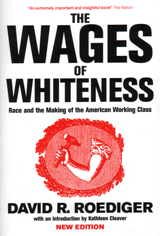
Below I have taken the liberty of copying and pasting sections from a review of the book that a few years back introduced me to "whiteness theory." I had taken a Harlem Renaissance course by then and read W.E.B. DuBois among others, but David Roediger presented something I had not thought about at all.
Here there are, a few fragments by Faron Levesque (Smith College):
"In _The Wages of Whiteness: Race and the Making of the American Working Class_ (1991), David Roediger writes that 'Even in an all-white town, race was never absent. I learned absolutely no lore of my German ancestry and no more than a few meaningless snatches of Irish songs, but missed little of racist folklore.'
By questioning why the main body of white, Marxist work has 'neutralized' whiteness and over-simplified race in the United States, Roediger concentrates the thematic structure of his sweeping analysis from this point of contention. The idea of 'profiting' socially, psychologically, and economically, from the 'wages of whiteness' is taken from the fundamental theory of W.E.B. Dubois. Emphasizing that even though white working classes earned low wages, Roediger asserts that their compensation went beyond the monetary to include a public and psychological wage. Moreover, 'Status and privileges conferred by race could be used to make up for alienating and exploitative class relationships, North and South. White workers could, and did, define and accept their class positions by fashioning identities as not slaves and as not Blacks.’
Within the historical legacy of racial invention, Roediger superimposes a constrained lens to question the evolving, technological operations of racial mechanisms amidst the objects of industry, folklore, humor, song, and language used to build an insidious racial hierarchy with ultimate staying power."
I decided to include these sections in my post because they capture the gist of that which altered the way that I think about race--my race--but also raise the problem of defining oneself as non-, or rather being the background against which others are made visible. They, like some points in Cathryn's post, also reverberate the blurry line (or so it seems to me) between reinforcing and redefining, or about how to change language, how to abandon stagnating words and categories in order to create new ones. I keep thinking about a professor's point with regard to attitudes such as racism, sexism, homophobia in the class room, namely not to engage them in a reasoned argument because that would validate them as equal or legitimate perspectives.

Michaela, I love the way you describe whiteness as the background against which others are made visible.
ReplyDeleteBefore I read these posts, I was thinking about this after a tutoring session yesterday- it was with someone for whom English is a second language. He wanted not only to get his writing carefully read by a native speaker, but also to understand the rules which would explain my corrections. Often, I don't really know the "rule" that could justify why something "sounds right" to my native, white, middle-class ear. I figure it out with the same tools available to my students (grammar books, handbooks, the OWL). I brought it up then to my students in class- "how," I asked them, "if you edit based on what sounds right, do you train your ear for what is right? How do you know whose ear to trust or imitate?" How indeed? There was something explicitly racist in the way my tutee from early in the day had invested authority in my ear for rightness (whiteness). Did it have as much to do with my looking and sounding like a native American English speaker as it did with the knowledge I have? I believe so.
That causes me to wonder: we often talk about countering our own racism as we deal with others, but what about the frequently positive racism that we encounter as authoritative and/or white speakers? Do we believe we somehow have more knowledge and authoritive over white English? Do we?